

Overview
This session explores the strategy of leveraging AI to move beyond manual implementation and into the next level of data engineering. We dive into a process that positions the AI not as a syntax generator, but as a cognitive partner in the engineering lifecycle. We will examine the architectural shift required to transform raw data lake assets into high-performance, orchestrated systems, focusing on the strategic collaboration between human intent and agentic design.
🚀 Featured Open Source Projects
Explore these curated resources to level up your engineering skills. If you find them helpful, a ⭐️ is much appreciated!
🏗️ Data Engineering
Focus: Real-world ETL & MTA Turnstile Data


🤖 Artificial Intelligence
Focus: LLM Patterns and Agentic Workflows


📉 Machine Learning
Focus: MLOps and Productionizing Models


💡 Contribute: Found a bug or have a suggestion? Open an issue! and be part of the open source project.
🔗 Related Repository: AI Agents for Data Engineering

Explore the full implementation of the AI Agents used in this workflow:
https://github.com/ozkary/data-engineering-mta-turnstile/tree/main/ai-agents
YouTube Video
👍 Subscribe to the channel to get notify on new events!
📅 Agenda
- Data Lake Discovery: The strategy of deploying discovery agents to autonomously identify patterns and define the foundation of the data grain.
- Governance & Requirements: Establishing the strategic guardrails and requirements that empower an "Architect" agent to maintain system consistency.
- Logical Design for the Staging Area: A process dive into using AI to propose and build a logical abstraction layer, separating raw sources from core business logic.
- Designing and Implementing the Physical Model: How agents navigate the transition to physical storage, building Dimension and Fact tables while maintaining referential integrity.
- Incremental Update Strategy: Developing a sustainable approach to support continuous data feeds from the data lake using idempotent, self-healing processes.
- Pipeline Design and Orchestration: The coordination of complex tasks to manage the relationship between dimensions and facts, ensuring strict lineage and integrated observability.
⭐ Why Attend?
- Elevate Your Role: Learn how to shift your focus from writing repetitive code to defining high-level architectural intent and performing strategic design reviews.
- Master Systemic Reasoning: Understand how to leverage AI to solve complex engineering challenges like referential integrity and dependency management at scale.
- Build for Operations: Move toward a model where system health and observability are built-in byproducts of the design process, not afterthoughts.
👥 Who Is This For?
- Data Engineers & Architects: Looking to evolve their workflow from manual scripting to high-level systemic design.
- Engineering Leaders: Interested in the ROI and reliability of integrating autonomous agents into the development lifecycle.
- AI Enthusiasts: Wanting to see a practical, "beyond-the-chatbot" application of agentic reasoning in a production environment.
- Technical Decision Makers: Seeking a strategy for maintaining governance and referential integrity in an AI-augmented organization.
Presentation
Automating the Data Engineering Lifecycle
We are running a modern Data Engineering process by combining the reasoning power of AI Agents with the standardized connectivity of MCP tools.
- Goal: Move from manual scripting to an intelligent, agent-led pipeline.
- Outcome: A system that can discover, map, and orchestrate data across the cloud.
How do we leverage these tools?
The "Brains" and the "Hands" of the process.
- AI Agents: Use Large Language Models (LLMs) to understand complex system instructions and specific user prompts. They provide the "logic" behind the process.
- MCP Tools: Provide the "connectivity." They expose metadata to the agent, which allows the AI to understand exactly what actions are available and how to execute them correctly.
How does this all work?
The Execution Loop
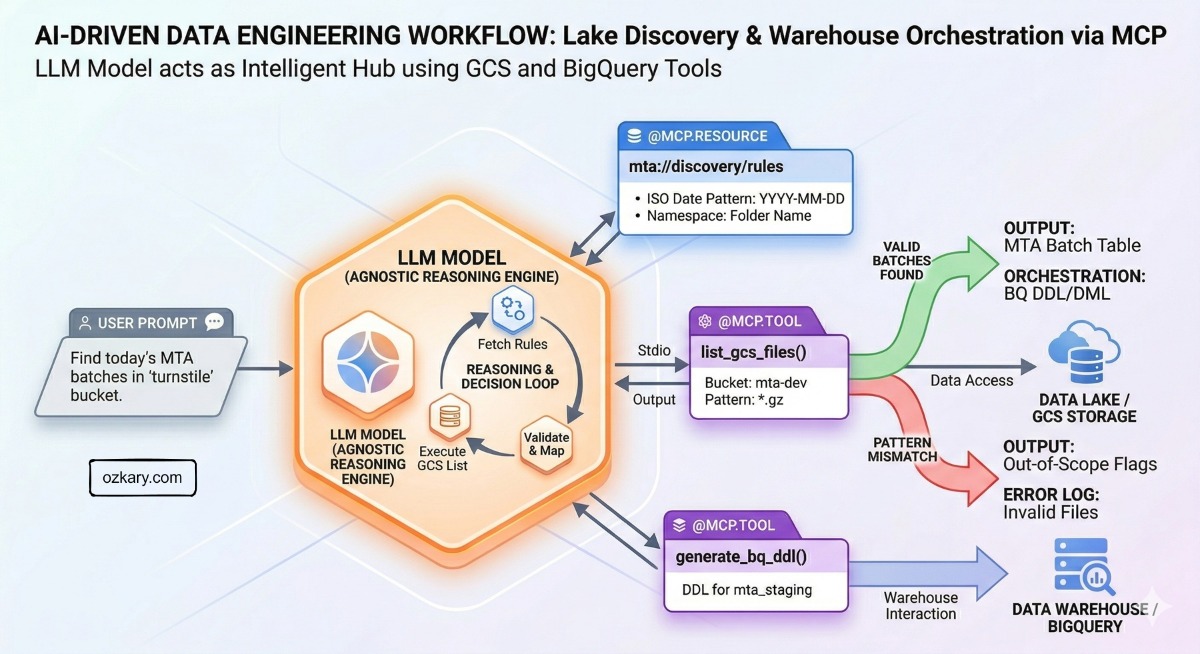
- The Model: The agent calls a managed LLM service in the cloud (Gemini) for high-level reasoning.
- Discovery: The agent "sees" the available MCP tools and automatically understands how to use them to interact with GCS or BigQuery.
- Governance: System Prompts provide the guardrails, core requirements, and engineering standards the agent must follow.
- Action: The User Prompt provides the specific task (e.g., "Find today's files"). The agent then executes the work.
Intelligent Orchestration
We build an AI-powered Data Engineering process that successfully handles:
- Data Lake Discovery: Automatically identifying patterns and namespaces in GCS.
- Data Warehouse Orchestration: Mapping those discoveries directly into BigQuery and creating the data models for analysis.
AI-Driven Data Engineering
- Agents can connect to a data lake and run discovery on the file
- Agents can use the result of the discovery to build external tables, views, tables and even stored procedures for the incremental update process
🌟 Let's Connect & Build Together
Thanks for reading! 😊 If you enjoyed these resources, let's stay in touch! I share deep-dives into AI/ML patterns and host community events here:
- GDG Broward: Join our local dev community for meetups and workshops.
- Global AI Events: Join Global AI Events.
- LinkedIn: Let's connect professionally! I share insights on engineering.
- GitHub: Follow my open-source journey and star the repos you find useful.
- YouTube: Watch step-by-step tutorials on the projects listed above.
- BlueSky / X / Twitter: Daily tech updates and quick engineering tips.
👉 Originally published at ozkary.com